
Submit a Project
Open Call for Projects
The Open Call is an opportunity for organizations, businesses, institutions, property owners, and community partners to submit projects for consideration in the Ithaca DRI Strategic Investment Plan. Proposed projects seeking DRI funding should catalyze future downtown revitalization, further the community's vision and goals, and benefit a growing downtown.
How to submit a project for DRI funding consideration:
Review the submission guidance, eligibility criteria, and evaluation criteria below.
Fill out the Intent to Submit form.
Fill out the Open Call form (open from Aug 20 - Oct 1, 2026).
Please review the Preliminary Guide to determine which application is most suitable for your project.
Fill out the Intent to Submit Form
If you are considering submitting a project for DRI funding,
please complete the Intent to Submit Form to let us know
about your proposal.
What is a transformative project?
A transformative project:
Has visible and functional impacts on the DRI Area
Benefits current residents and future generations
Catalyzes secondary private and public investment in the DRI Area, bringing in more people and activity
Provides employment opportunities, housing choices and/or services to the community
Please ensure that you scroll through and complete the form in its entirety.
This form cannot be saved as a draft and will need to be completed and submitted in one sitting.
Open Call - Standalone Projects
Please fill out this project application form if you are applying for over $75,000 in DRI funding. If your DRI funding requirement is under $75,000, please scroll down to access the Small Project Fund Interest Form.
Completed applications are due by October 1, 2026. If you have any questions or clarifications regarding the form or eligibility criteria, please email the project team at info@ithacadri.com.
You may choose to fill out the online form, or use the interactive PDF. Project sponsors using the interactive PDF must email the completed PDF form to info@ithacadri.com.
Open Call - Small Project Fund
Please fill out this interest form if you are applying for under $75,000 in DRI funding.
*Project awards are generally between $25,000 and $150,000 per building/project, with the grant request not to exceed 75% of the total eligible project cost. Up to $200,000 could be requested if the project includes directly improving or creating at least two residential units.
Completed applications are due by October 1, 2026. If you have any questions or clarifications regarding the form or eligibility criteria, please email the project team at info@ithacadri.com.
You may choose to fill out the online form, or use the interactive PDF. Project sponsors using the interactive PDF must email the completed PDF form to info@ithacadri.com.
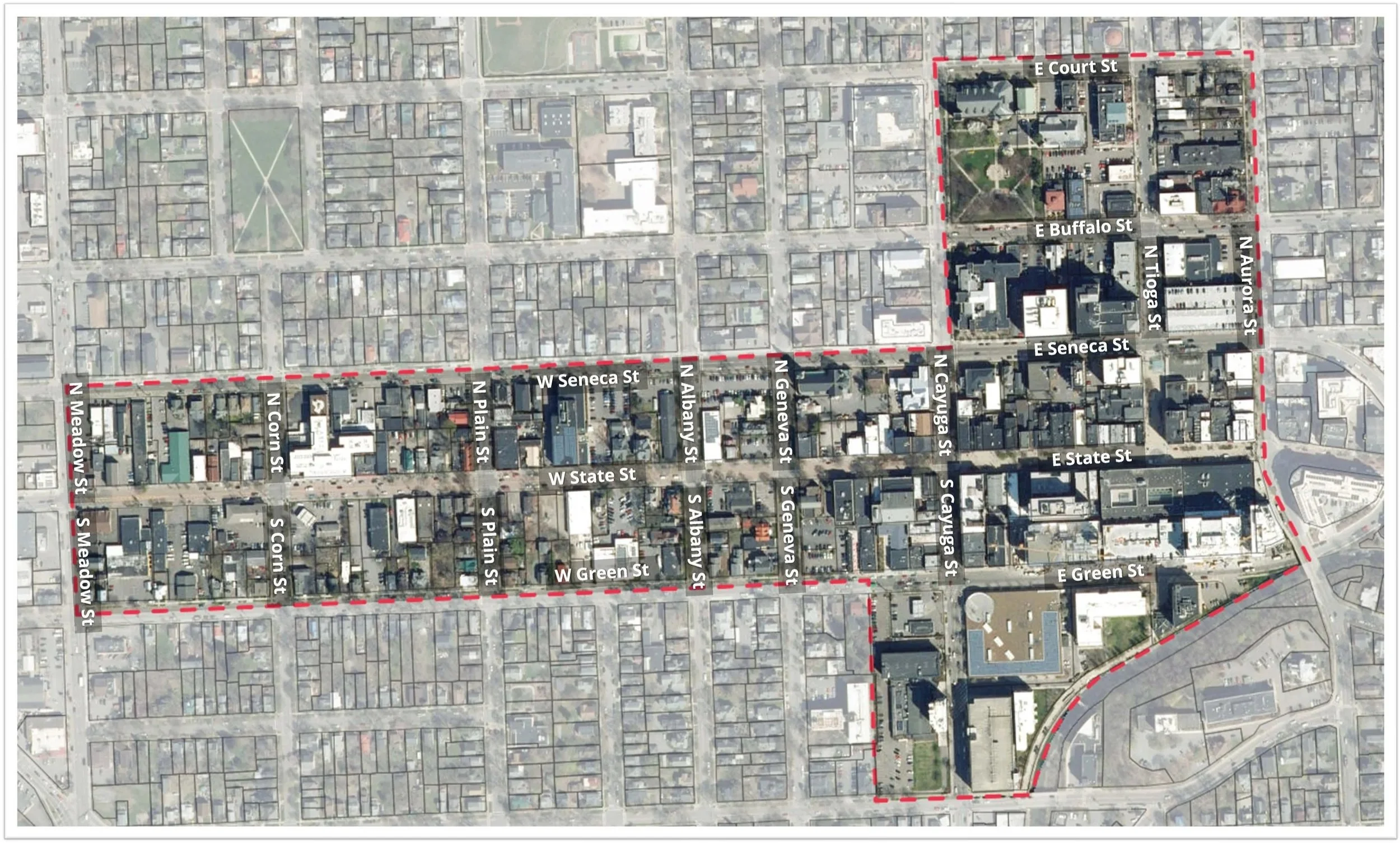
DRI Area
Project Requirements
The following are the requirements for projects to be considered for DRI funding. Recognizing that several requirements must be met to qualify for DRI funding, each project sponsor will have access to technical support from State agencies and the consultant team to assist with project development (i.e. construction cost estimates, renderings, climate resilient design, meeting decarbonization requirements, etc.)
Project Location | Projects must be located within the DRI area boundary. If your project is located outside the DRI boundary, please provide a brief description of how the project relates to the downtown and supports the stated goals of the DRI. Minor boundary modifications may be considered by the LPC.
Project Timing | Projects must be able to break ground within two years or sooner of receiving DRI funding.
Project Size and Scale | Projects must be large enough to be truly transformative for the downtown area. Standalone DRI projects must be at least $75,000 in total project cost. Projects coming in under $75,000 can be submitted through the Small Project Fund application form. If you have a project that is under $75,000 in total project costs, please contact the consultant team at info@ithacadri.com for more information.
Project Funding | Projects should have financial commitments largely secured or be able to demonstrate a clear path to securing sufficient financing. It is strongly encouraged that all projects, especially private projects, use non-DRI funds that leverage requested public funding. Projects that use other funding sources will be more competitive for funding awards.
For projects with a private sponsor, there is a minimum match requirement of 25% of the total project cost.
There is no minimum match requirement for public or non-profit projects.
Project Sponsors | Every project must have an identified project sponsor. Sponsors may be public, not-for-profit, or private entities with the capacity and legal authority to undertake the proposed project. Proposals with project sponsors that are membership-only organizations or religious facilities must propose projects that are available to the public and not just to active members.
Building Decarbonization | For DRI communities, all public, private, and non-profit projects that meet the criteria for new construction, substantial renovation, or a building addition shall include decarbonization techniques. Each project that meets the criteria will be required to select a method of demonstrating that the project satisfies the requirements More information on this requirement can be found in the DRI/NY Forward Guidebook.
If your project does not meet all of the criteria described in this section, we still want to hear your project idea!
Eligible Project Types
New Development and/or Rehabilitation of Existing Downtown Buildings | Projects in this category may include the development or redevelopment of real property for mixed-use, commercial, residential, not-for-profit, or public uses. All projects should be capital investments or should lead to capital investments. They should have a visible and functional impact on the downtown, serving as catalytic or transformative projects that will provide employment opportunities, housing choices, and/or services for the community. Standalone parking facilities are ineligible for DRI funds.
Public Improvement Projects | These may include streetscape and transportation improvements, recreational trails, wayfinding signage, new and upgraded parks, plazas, public art, green infrastructure, and other public realm projects that will contribute to the revitalization of the downtown.
Branding and Marketing | Downtown branding and marketing projects may target residents, investors, developers, tourists, and/or visitors. The costs eligible under this category must be one-time expenses, such as developing a network of downtown signs or a major public art display. Ongoing operational costs, such as funding a downtown manager or maintaining a website, are not eligible for DRI funding. This project type is intended for the overall branding and marketing of a downtown, not to provide branding and marketing services to individual downtown businesses or other entities.
Small Project Fund | One Small Project Fund may be proposed per DRI community to undertake a range of smaller downtown projects such as facade enhancements, building renovations or public art. Small Projects typically have a budget of $75,000 or less, but may reach a maximum request of $150,000, or $200,000 if a small project produces or improves at least two units of housing. Funds are capped at $600,000 for DRI communities. Each project undertaken under the Small Project Fund must individually meet financial matching requirements.
Ineligible Project Types
DRI funds must be capital in nature, implemented quickly, and as a whole, have a transformational impact on the downtown. Several activities are ineligible for DRI funds and should not be included in projects proposed for DRI funding. These include:
Standalone Planning Activities | DRI funds cannot be used for plans or studies, unless directly associated with a capital project (e.g. architectural plans for a new building).
Operations and Maintenance | DRI funds cannot be used for ongoing or routine expenses, such as staff salaries and wages, rent, utilities, and property upkeep.
Pre-Award Costs | Reimbursement for costs incurred before the announcement of funding awards is not permitted. Funding announcements typically occur three to six months following submission of the SIP.
Property Acquisition | The cost of property acquisition can be included in the overall project budget, but the acquisition must be funded by another funding source.
Training and Other Program Expenses | The DRI and NYF programs are a one-time infusion of funds and cannot be used to cover continuous costs, such as training costs and expensed related to existing programs.
Evaluation Criteria
In addition to the eligibility requirements above, alignment with the community’s vision and goals will be a key criterion for evaluation of projects submitted through the Open Call. Please review the following draft Vision, Goals, and Local Evaluation Criteria before submitting your proposal. These criteria will be finalized by the Local Planning Committee at their third meeting on September 16th.
Draft Vision
Through investment in the West State/MLK Jr. Corridor, the West End and Downtown will become a continuous, activated, and accessible district and is defined by creativity, diversity, and opportunity. Vacant spaces will be transformed into affordable homes, businesses, and public amenities that create a true mixed-use, multi-hour downtown. With equity, collaboration, and sustainability as core principles, Downtown Ithaca will grow in a way that strengthens both the community and the environment.
Draft Goals
A Complete Downtown: Create a true mixed-use downtown that serves a diverse mix of users: workers, students, visitors, and a growing residential population.
A Connected, Welcoming Public Realm: Create a visually and physically connected Downtown with a unified public realm that draws people in and is welcoming, accessible, and easy to navigate for people of all ages, abilities, and modes of transportation.
Housing Affordability and Supply: Build housing serving all income levels in Downtown, prioritizing affordable and workforce units and supporting Ithaca’s continued growth in one of the city’s densest and most amenity-rich areas.
Arts, Culture, and Vitality: Center arts and culture in Downtown’s next chapter, celebrating Ithaca’s nationally significant creative community and unique diversity.
Draft Local Evaluation Criteria
The Local Planning Committee has not established any additional Local Evaluation Criteria at this time, but will discuss doing so at their third meeting on September 16th.